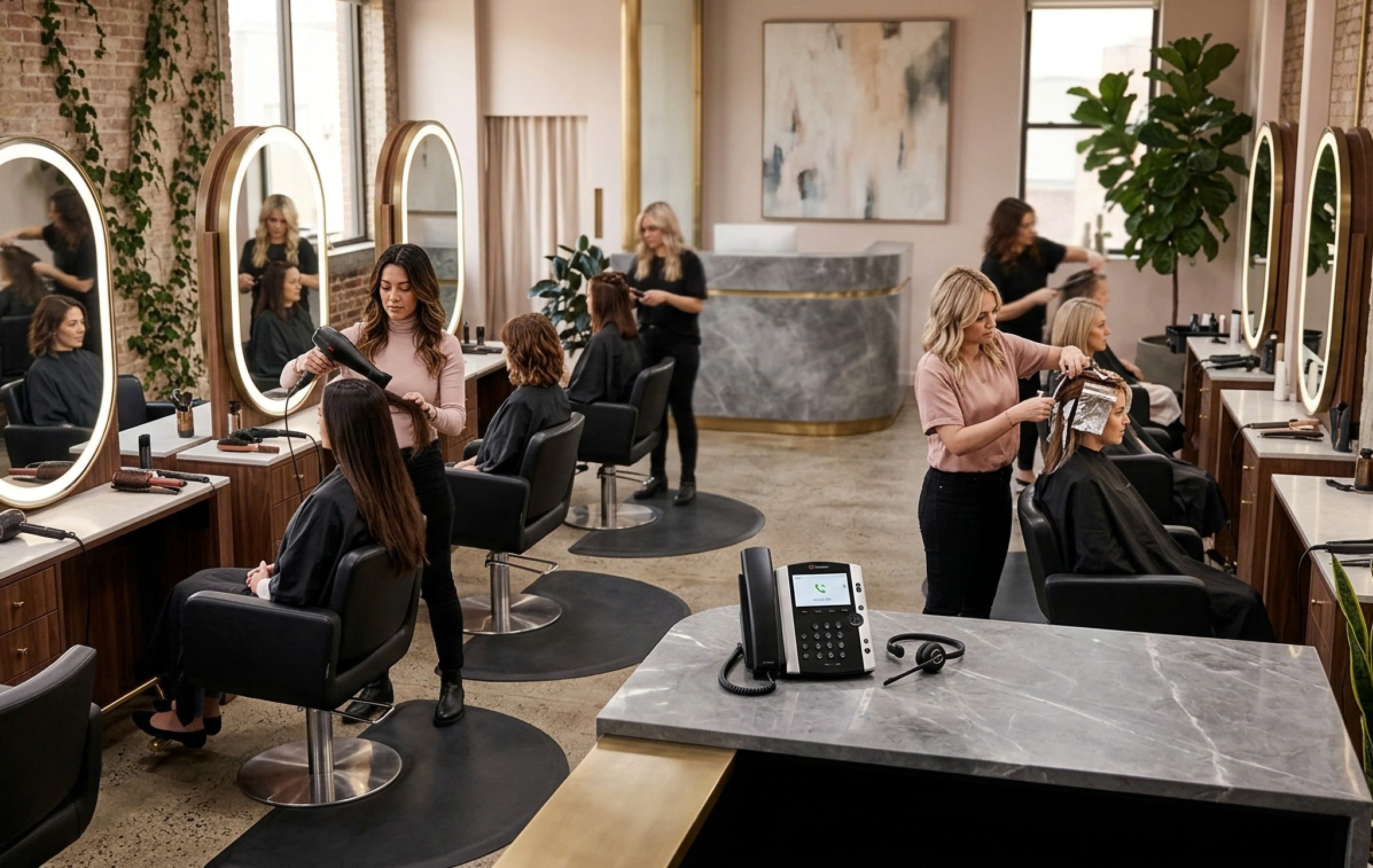
Most salon owners do not think of missed calls as a revenue line.
They think of them as small front-desk friction. A few rings during busy hours. A voicemail to return later. A customer who might call back.
But in beauty businesses, that is rarely what happens.
When a call goes unanswered, the booking often disappears. The caller tries another salon, the same-day slot stays empty, or the lead dies in voicemail. Over time, that small phone problem turns into a much bigger revenue leak than most owners realize.
The phone problem is bigger than most owners think
Some small-business call-handling studies estimate that around 62% of incoming business calls go unanswered. Beauty-specific data points to a still serious number: 37% of calls are missed, and 82% of those missed calls happen during business hours, not after closing.
That means the issue is not just a few missed calls at night.
It is what happens when your team is already busy with clients, the phone rings, no one picks up, and the booking opportunity disappears.
Online booking did not remove the phone problem
A lot of beauty businesses assume online booking should have solved this already.
It has not.
Industry data shows that 52% of salon and spa regulars still say calling is the easiest way to update appointments, and 50% say they regularly need after-hours support. On top of that, 71% say they have skipped booking because it was too hard to reach someone or use the online system.
The phone still matters, especially when the request is urgent, specific, or easier to explain out loud.
Why salon calls go unanswered
In beauty businesses, missed calls are usually operational, not accidental.
Nail salons
Nail salons often deal with short, repetitive, time-sensitive calls while staff are already serving clients. Many callers want quick answers about walk-ins, same-day availability, pricing, or reschedules.
Hair salons
Hair salons get more relationship-driven calls. Clients may ask for a specific stylist, a longer color-service booking, or want to reschedule without losing their preferred provider.
Spas
Spas deal with callers asking about packages, appointment length, couples bookings, or after-hours availability while therapists are in treatment.
Med spas
Med spas often handle higher-value calls, especially consultation requests. These calls need fast response and a smoother handoff when the request becomes more complex.
Voicemail is a weak backup
Many owners assume missed calls are recoverable because callers can leave a voicemail.
That assumption is expensive.
Beauty-industry data shows only 24% of callers who reach voicemail leave a message.
That means voicemail is often not a recovery system. It is a dead end.
The $45,000 problem
The title says $45,000, so let’s make that real.
This is not a universal benchmark. It is a realistic model for a busy salon or spa.
Example
Assume a salon misses 12 calls per week that had real booking intent.
Now assume:
- only 1 in 3 missed-call opportunities could have been converted into a booked appointment with better call handling
- your average recovered appointment value is $75
- and some of those clients come back again over time
If you recover:
- 4 appointments per week
- at $75 each
- over 52 weeks
That is:
$15,600 per year in direct first-booking revenue.
Now add repeat visits, add-on services, or retained clients over time, and the number climbs quickly. Even if only a portion of those recovered bookings turn into repeat customers, reaching $45,000 in annualized lost revenue impact is not difficult for a salon with healthy volume.
That is why missed calls are not just a communications problem.
They are a revenue leakage problem.
The biggest issue is not after hours
After-hours coverage matters, but it is only part of the problem.
Beauty-specific data shows that 82% of missed calls happen during business hours.
That means the bigger issue is not simply that the business was closed.
It is that the business was open, busy, and unable to answer fast enough.
Why the problem gets worse in peak hours
The highest-risk moments are often the exact moments your salon looks busiest and most successful:
- Friday afternoons
- Saturdays
- lunch rush
- holiday weeks
- pre-event weekends
- same-day reschedule windows
That is when:
- staff are with clients
- the front desk is handling check-ins and checkouts
- incoming calls stack up
- callers need a fast answer
- and voicemail becomes a dead end
A missed call is not just one missed appointment
A missed call can mean more than one lost service.
It can mean:
- a same-day slot stays empty
- a cancellation opening goes unfilled
- a new client books elsewhere
- a high-value consultation disappears
- a returning client gets frustrated and becomes less loyal
Loyalty matters in beauty. Many clients prefer booking with the same stylist, therapist, or provider, so a poor phone experience can hurt both immediate revenue and long-term retention.
What better-run salons do differently
The strongest operators are not trying to eliminate the phone.
They are trying to stop the phone from leaking money.
That usually means:
- answering on the current number
- covering after-hours and overflow
- handling reschedules, cancellations, and booking calls
- avoiding voicemail dead ends
- using missed-call text back
- escalating to a real person when needed
The real takeaway
If you own a salon, spa, or clinic, the question is not whether missed calls are happening.
They are.
The question is whether you are measuring the cost honestly.
Because once you combine:
- unanswered calls during business hours
- after-hours demand
- weak voicemail recovery
- skipped bookings
- and repeat customer value
the number stops looking like a minor admin issue.
It starts looking like a revenue leak that can quietly cost tens of thousands of dollars a year.
That is why this matters:
not because AI is trendy, but because the phone is still where too many bookings are won or lost.
FAQ
Do salon clients still prefer calling?
Often, yes. Many salon and spa regulars still find calling the easiest way to update appointments.
How many salon calls go unanswered?
The exact figure varies by source. Some small-business studies cite numbers around 62% unanswered, while beauty-specific data reports 37% of calls are missed, with most missed during business hours.
Do people leave voicemail when salons miss calls?
Usually not. Only a minority of callers who reach voicemail leave a message.
Is after-hours support really that important?
Yes. Many salon and spa regulars still need after-hours support.
What is the best fix for missed calls?
The most practical fix is not replacing your whole system. It is improving after-hours coverage, overflow handling, missed-call recovery, and reschedule or cancel workflows on your current number.
